How Metal, Polymer, Urethane, and 3D-Printed Shoes Affect Hoof Comfort
Not all horseshoes are made the same.
The material under your horse’s feet plays a major role in:
- Comfort
- Impact absorption
- Pressure distribution
- Hoof wall stress
- Overall movement
Understanding how different shoe materials behave can help owners make more informed choices, especially for horses with sensitive or compromised hooves.
Metal Shoes: Strong, Durable, and Traditional
Common materials: Steel, aluminum
Strengths:
- Very durable
- Excellent traction options
- Widely available
- Familiar to most farriers
Limitations:
- Rigid (no cushioning)
- Transmit impact forces directly into the hoof
- Rely on nails for attachment
- Fixed shapes and breakover
Metal shoes work well for many healthy horses, especially those in performance or high-wear environments. However, for compromised hooves — such as those affected by laminitis, white line disease, thin soles, or wall weakness — rigidity and nail fixation can increase mechanical stress.
Metal shoes protect the hoof, but they do not absorb shock or adapt easily to distorted hoof shapes.
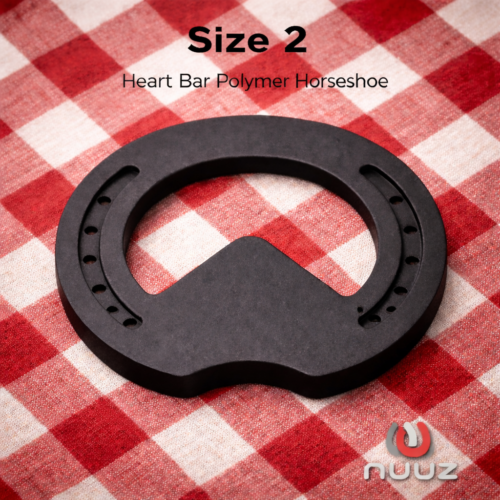
Polymer & Composite Shoes: More Flexibility, Less Impact
Common materials: Thermoplastics, composite blends
Strengths:
- Lighter than metal
- Slightly more flexible
- Can reduce impact transmission
- Often used in glue-on systems
Limitations:
- Less durable than steel
- Still manufactured in standard shapes
- Limited customization without modification
Polymer shoes can offer improved comfort over metal in some cases by reducing vibration and impact forces. Many glue-on systems use polymer bases to avoid nail trauma and better support fragile hoof walls.
However, most polymer shoes are still mass-produced, meaning they may not match a horse’s unique hoof geometry.
Urethane Systems: Cushioning and Shock Absorption
Common uses: Pads, glue-on shoes, frog support, cuffs
Strengths:
- Soft and compressible
- Absorbs shock
- Distributes pressure
- Can support the frog and sole
Limitations:
- Can compress over time
- Needs correct placement
- Not structural on its own
Urethane materials are widely used to improve comfort, especially for horses with:
- Thin soles
- Bruising
- Heel pain
- Sensitive frogs
They help reduce peak pressure and provide a softer interface between the hoof and the ground. Urethane alone doesn’t control hoof geometry, but it plays an important comfort role.
Pour-In Pads: Filling the Gaps
Purpose: Cushioning and sole protection
Strengths:
- Protect thin soles
- Fill voids under the hoof
- Reduce debris intrusion
- Add frog/sole support
Limitations:
- Temporary
- Uniform softness
- Limited precision
Pour-in pads are commonly used to provide quick comfort for sensitive hooves. They can help distribute load and protect the sole, but they are not customizable to individual pressure patterns.
They offer general comfort, not targeted mechanical support.
Why Material Alone Isn’t Enough
Each material has strengths — but no single material can do everything:
| Need | Best Material |
|---|---|
| Structural control | Metal / rigid polymer |
| Cushioning | Urethane / TPU |
| Nail-free attachment | MMA + polymer |
| Shock absorption | Urethane |
| Precision fit | 3D-printed |
Comfort depends not just on the material, but on how it’s used.
That’s where customization matters.
Where 3D-Printed Shoes Change the Game
3D printing allows horseshoes to be designed around your horse’s actual hoof, not an average template.
With digital design, shoes can be:
- Shaped to match hoof asymmetry
- Tuned for breakover
- Designed for frog support
- Adjusted for heel height
- Paired with soft inserts
This is especially valuable for:
- Laminitic hooves
- White line disease
- Capsule distortion
- Thin soles
- Chronic sensitivity
- Hard-to-shoe horses
Instead of forcing the hoof to adapt to a stock shoe, the shoe adapts to the hoof.
Multi-Material Designs: Structure + Comfort
3D-printed systems can combine:
- Rigid frames for support
- Soft TPU inserts for cushioning
- Urethane interfaces for shock absorption
- Glue-on attachment to protect weak walls
This mirrors how orthotic devices work in human medicine:
Structure for alignment, softness for comfort.
No traditional horseshoe material can provide this level of functional separation in one system.
What Owners May Notice with Better Material Matching
When shoes match the horse’s comfort needs, owners often report:
- Easier movement
- Less hesitation on hard ground
- Calmer reset days
- Less resistance to hoof handling
- Improved posture
- Better confidence
Behavior often reflects comfort.
This Isn’t About Replacing Farriers or Tradition
Farriers remain essential.
Metal shoes still have a place.
Not every horse needs advanced materials.
But modern materials, especially custom 3D-printed designs, expand what’s possible for horses who need more individualized support.
Final Takeaway
Horseshoe materials matter.
- Metal offers strength
- Polymers offer flexibility
- Urethanes offer cushioning
- Pour-ins offer protection
- 3D-printing offers precision
The best solution isn’t about choosing one material,
It’s about choosing the right combination for your horse’s comfort and needs.
FAQ for Owners
Are metal shoes bad?
No. They’re durable and effective for many horses.
Are softer materials better?
They can improve comfort, especially for sensitive hooves.
Are 3D-printed shoes permanent?
They’re often used in therapeutic or support roles, not always long-term.
Will new materials fix my horse’s condition?
They support comfort but don’t cure disease.
Should I ask my farrier about options?
Yes, informed conversations lead to better outcomes.
Call to Action
If your horse has sensitive or compromised hooves, materials matter.
Talk with your farrier about:
- Cushioning options
- Nail-free systems
- Custom-fit solutions
- Comfort-focused materials
Because the right material choice can make every step easier for your horse.
About the author : Walt Jaeger