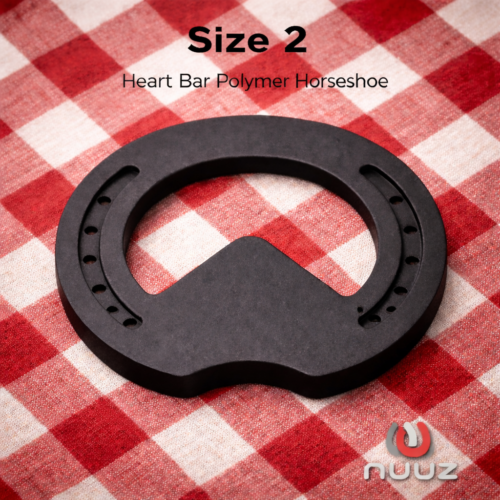
Improving Quality of Life for Horses with Compromised Hooves
No two horses have identical hooves. Even the same horse’s left and right feet differ in shape, load patterns, and wear. Yet most horseshoes on the market are mass-produced to fit an “average” hoof.
For healthy horses in light work, this may be acceptable.
For horses with founder (laminitis), white line disease, or navicular syndrome, it often is not.
In these cases, custom-designed and custom-fit horseshoes consistently provide better mechanical support, improved comfort, and a higher long-term quality of life than off-the-shelf shoes.
Off-the-Shelf Shoes Are Built for Average Hooves
Commercial horseshoes are manufactured around:
- Standard widths and lengths
- Generic toe and heel shapes
- Fixed breakover positions
- Uniform support zones
However, research shows that shoeing alters hoof deformation, expansion, and strain patterns, and these effects vary depending on shoe design and attachment.
Studies measuring hoof wall strain confirm that nail placement and shoe constraint significantly influence hoof deformation and stress distribution (McClinchey et al., 2023).
This means a shoe that “fits” by size may still mechanically mismatch the horse’s real hoof geometry and loading needs.
Custom Shoes Match the Horse’s True Hoof Geometry
A custom-designed horseshoe is built around:
- The horse’s exact hoof shape
- Existing capsule distortion
- Pathology-specific support needs
- Individual breakover requirements
- Limb loading patterns
Instead of forcing the hoof to adapt to a generic shoe, the shoe is engineered to support the hoof.
Biomechanical research confirms that shoe configuration changes hoof deformation patterns and internal bone motion, particularly in laminitic hooves (Hobbs et al., 2023). Custom designs allow these mechanical variables to be optimized for the individual horse.
How Custom Shoes Improve Quality of Life
1. Reduced Pain Through Better Load Distribution
Custom shoes can:
- Offload damaged laminae
- Support the frog and sole
- Reduce heel pain
- Minimize toe leverage
Research on laminitic horses shows that modifying shoe configuration can reduce distal phalanx (P3) motion and stabilize the hoof capsule, lowering mechanical stress on injured structures (Hobbs et al., 2023).
Less stress = less pain = better mobility.
2. Improved Stability for Weak Hoof Capsules
White line disease and laminitis weaken the hoof wall internally, creating structural instability.
Custom shoes can:
- Shift load to stronger wall regions
- Reduce separation forces
- Support compromised capsules
- Protect thin soles
Generic shoes cannot accommodate these internal weaknesses. Custom support helps prevent further distortion and promotes healing rather than continued breakdown.
3. Optimized Breakover for Joint and Tendon Relief
Breakover placement affects:
- Tendon strain
- Joint loading
- Heel comfort
- Gait symmetry
Orthopaedic studies show that altering breakover mechanics in laminitic horses can reduce lamellar stress and improve comfort (van Heel et al., 2020). Custom shoes allow precise breakover placement based on the horse’s actual hoof-pastern alignment, not a factory default.
This is especially beneficial for navicular horses, where reducing deep digital flexor tendon strain improves comfort.
4. Better Hoof Mechanics and Circulation
Research comparing barefoot and shod hooves confirms that shoes restrict natural hoof expansion, and the degree of restriction depends on shoe design and attachment (McClinchey et al., 2023).
Custom shoes can be designed to:
- Preserve more natural deformation
- Support caudal hoof structures
- Improve functional circulation
Better circulation supports horn growth, tissue repair, and long-term hoof health.
5. Fewer Complications, Longer Soundness
Because custom shoes match the hoof’s real needs:
- Wall damage is reduced
- Fewer cracks and separations develop
- Shoes stay secure longer
- Horses remain comfortable between resets
Over time, this leads to:
- Fewer setbacks
- Less reliance on medication
- More consistent comfort
- Longer functional lives
Why Compromised Hooves Need Custom Solutions
Founder (Laminitis)
Laminitic hooves require:
- Reduced toe leverage
- Sole protection
- Caudal support
- Capsule stabilization
Studies show shoe configuration directly affects internal hoof motion and lamellar stress in laminitic horses (Hobbs et al., 2023; van Heel et al., 2020). Custom shoes allow these variables to be optimized for each case.
White Line Disease
White line disease weakens the hoof wall internally, creating unpredictable load paths. Custom shoes can:
- Avoid compromised wall regions
- Shift load to healthy structures
- Reduce separation forces
- Protect thin soles
Generic shoes cannot accommodate these structural defects effectively.
Navicular Syndrome
Navicular horses benefit from:
- Heel support
- Reduced tendon strain
- Optimized breakover
- Improved caudal hoof mechanics
Evidence-based farriery research shows shoe configuration affects tendon strain and distal limb load distribution (Clayton et al., 2011). Custom shoes allow these parameters to be tuned to the individual horse’s needs.
Quality of Life Is About Comfort, Not Just Soundness
A horse does not need to be perfectly sound to have a good life.
But it does need to be:
- Comfortable
- Confident in movement
- Free from constant pain
- Able to move naturally
Custom horseshoes help achieve this by:
- Reducing mechanical stress
- Supporting damaged structures
- Improving comfort
- Encouraging healthier movement
For compromised horses, this often means:
- More turnout time
- Better mobility
- Less medication
- Happier behavior
- Longer functional lives
Final Takeaway
Off-the-shelf horseshoes are built for average hooves.
Compromised hooves are never average.
Custom-designed and custom-fit horseshoes provide:
- Better mechanical support
- Reduced pain
- Improved stability
- Optimized breakover
- Enhanced comfort
- Higher long-term quality of life
For horses with founder, white line disease, or navicular syndrome, custom shoeing is not a luxury, it is often the most humane, effective, and responsible choice.
FAQ (For Google Rich Snippets)
Are custom horseshoes better for laminitis?
Research shows shoe configuration affects lamellar stress and internal hoof motion. Custom shoes allow precise mechanical support for laminitic hooves.
Do off-the-shelf shoes harm compromised hooves?
They may not accommodate distorted hoof geometry or internal weaknesses, potentially increasing stress on damaged structures.
Are custom shoes only for therapeutic cases?
No, but they provide the greatest benefit for horses with hoof pathology or chronic pain.
Do custom shoes improve comfort?
Yes. By matching the horse’s biomechanics, they reduce painful stress concentrations.
References (Research-Based)
McClinchey HL et al. (2023). Effect of horseshoe attachment on hoof wall strain and deformation. Journal of the Royal Society Interface.
https://pmc.ncbi.nlm.nih.gov/articles/PMC10251877/
Hobbs SJ et al. (2023). Influence of shoeing configuration on distal phalanx displacement in laminitic horses. PLOS ONE.
https://journals.plos.org/plosone/article?id=10.1371/journal.pone.0285475
van Heel M et al. (2020). Effect of heel elevation on breakover mechanics in laminitic horses. Equine Veterinary Journal.
https://pmc.ncbi.nlm.nih.gov/articles/PMC7528610/
Clayton HM et al. (2011). Evidence-based assessment of the biomechanical effects of shoeing techniques. Equine Veterinary Journal.
Optional Call-To-Action
Looking for custom hoof solutions for a compromised horse?
Work with professionals who understand biomechanics, pathology, and precision fit.
We will work with your veterinarian or farrier to get you the optimal shoe for your horse!
Contact us to learn more about custom-designed horseshoes for therapeutic and performance applications.
About the author : Walt Jaeger